• CRAFT AS LANGUAGE

    Bossa Furniture debuts a new exhibition for Design Miami 2025

    A dialogue between Joaquim Tenreiro and Lucas Recchia, presented in relation to Miami’s ongoing cycles of preservation and urban reinvention.


    For its first participation in Design Miami/, Bossa presents Craft as Language, an exhibition that explores how material knowledge moves across generations and how cities—like objects—construct their identities through deliberate acts of preservation and renewal. Featuring mid-century master Joaquim Tenreiro and contemporary designer Lucas Recchia, the project aligns with Design Miami’s 20th-anniversary theme, Make. Believe.


    In Miami, the exhibition takes on a new contextual frame. The city’s contemporary visual identity emerged in 1979, when the Art Deco buildings of Ocean Drive were landmarked and restored, introducing the pastel palette now synonymous with Miami. This moment illustrates how heritage and invention often operate together, and how cultural identity results from intentional choices.


    This perspective led Bossa to the work of photographers Andy Sweet and Bruce Weber, whose early-1980s images capture Miami just after this transformation. Their photographs show a city both radiant and slightly uncanny—sunlight, pastels, and geometry arranged with theatrical precision. Playful scenes carry a quiet tension, suggesting a Miami in continual negotiation with its own image. This process continued in the decades that followed through the evolution of Lincoln Road and the emergence of the Design District.


    Within this framework, the dialogue between Tenreiro and Recchia gains renewed resonance. Tenreiro’s Curva com Varetas, a rosewood chair of extraordinary lightness, exemplifies his ability to extract structural strength from minimal material. Recchia’s Eche armchair embraces volume and weight to propose a contemporary form of comfort, one that challenges conventional notions of ergonomics. Together, their practices reveal how craft functions as a language—capable of holding memory, revisiting history, and shaping new futures.


    A parallel presentation of Craft as Language will be on view at Bossa New York, and the gallery’s new publication, Joaquim Tenreiro: Inventing Modern Brazilian Design, will be available in both cities.


    Craft as Language will be presented at Design Miami from December 3–7, 2025.

  • JOAQUIM TENREIRO

  • Joaquim Tenreiro (1906–1992)
    Joaquim Tenreiro (1906–1992)

    A prolific and visionary artist, Joaquim Tenreiro masterfully laid the foundations for modern living in Brazil through his furniture, interiors, and cultural vision. Born in Portugal into a lineage of woodworkers, he trained as a craftsman from an early age and settled in Rio de Janeiro in the late 1920s. By the early 1940s, Tenreiro had opened his own studio and workshop, producing work that marked a clear rupture with the colonial aesthetics that had dominated Brazil until the 1930s — inaugurating a new era that reflected the country’s modern spirit and identity.


    Over the following decades, Tenreiro explored the expressive potential of Brazilian woods, cane, and upholstery, creating lighter and more ergonomic compositions that responded to the tropical climate and to the rhythms of modern life. His work redefined domestic environments as holistic spaces — merging furniture, architecture, and art — and offering a clear, refined, and distinctly Brazilian answer to what modern living could be.

  • When Tenreiro opened his first showroom in 1947 on Rua Barata Ribeiro in Copacabana, newspapers referred to it as Galeria... When Tenreiro opened his first showroom in 1947 on Rua Barata Ribeiro in Copacabana, newspapers referred to it as Galeria...

    When Tenreiro opened his first showroom in 1947 on Rua Barata Ribeiro in Copacabana, newspapers referred to it as Galeria Tenreiro — not a store, but a space dedicated to culture and art. Alongside his own works, he exhibited pieces by Bruno Giorgi, Burle Marx, Ivan Serpa, and Alfredo Volpi, establishing one of Rio’s first hubs for modern art and design. Instead of displaying furniture as isolated objects, he composed complete domestic settings that proposed a new way of living.

    A second showroom followed in 1953 in São Paulo, later relocating to the modernist Conjunto Nacional. These spaces embodied his philosophy: immersive environments where art, architecture, and life converged. Many clients commissioned him to design entire interiors — harmonious compositions that balanced clarity, warmth, and proportion. His rooms often united his furniture with paintings by Tarsila do Amaral or Di Cavalcanti, handcrafted ceramics, and Afro-Brazilian jewelry, expressing modernism not as a style but as a way of life.

  • In his 1955 article “Sobriety, Distinction, and Warmth,” Tenreiro argued that Brazilian creation should unite sophistication with authenticity, and modernity with craft. His work embodied these values — elegant, restrained, and rooted in the country’s materials and traditions. Though his artisanal approach limited production, his influence was vast. Rediscovered in the late 1980s, Tenreiro came to be recognized as a defining force in Brazilian modernism, shaping the sensibility later continued by Sergio Rodrigues, Jorge Zalszupin, and Claudia Moreira Salles. Through his mastery of material and form, Joaquim Tenreiro not only transformed interiors — he shaped a vision of modern Brazil that remains timeless in its restraint, cultural depth, and sense of place.

  • LEVE ARMCHAIR, 1942 The Leve armchair is one of the fundamental pieces in Brazilian Modern design history. Designed by Joaquim... LEVE ARMCHAIR, 1942 The Leve armchair is one of the fundamental pieces in Brazilian Modern design history. Designed by Joaquim... LEVE ARMCHAIR, 1942 The Leve armchair is one of the fundamental pieces in Brazilian Modern design history. Designed by Joaquim...

    LEVE ARMCHAIR, 1942

    The Leve armchair is one of the fundamental pieces in Brazilian Modern design history. Designed by Joaquim Tenreiro (1906-1992) in 1942, it is considered by its author his first and most significant creation. Leve means “light” in Portuguese, and the armchair is composed of slim and curved armrests in solid wood that elongate and turn into feet, supporting
    and highlighting a unique upholstered seat piece and backrests. Tenreiro described in his own words: “Lightness, which has nothing to do with the weight per se, but with grace and functionality in space.”
    The goal was to use a minimum of materials and lines for the object’s composition, and Tenreiro achieved it with success: Leve’s design synthesized the concepts of Brazilian Modernism, creating a new formal language in the 20th century through furniture design.
  • DINING CHAIRS WITH STICKS BACKS, 1948 This set of eight exquisitely crafted Cane Chairs in Amendoim Wood, designed by Joaquim... DINING CHAIRS WITH STICKS BACKS, 1948 This set of eight exquisitely crafted Cane Chairs in Amendoim Wood, designed by Joaquim... DINING CHAIRS WITH STICKS BACKS, 1948 This set of eight exquisitely crafted Cane Chairs in Amendoim Wood, designed by Joaquim... DINING CHAIRS WITH STICKS BACKS, 1948 This set of eight exquisitely crafted Cane Chairs in Amendoim Wood, designed by Joaquim... DINING CHAIRS WITH STICKS BACKS, 1948 This set of eight exquisitely crafted Cane Chairs in Amendoim Wood, designed by Joaquim... DINING CHAIRS WITH STICKS BACKS, 1948 This set of eight exquisitely crafted Cane Chairs in Amendoim Wood, designed by Joaquim...

    DINING CHAIRS WITH STICKS BACKS, 1948

    This set of eight exquisitely crafted Cane Chairs in Amendoim Wood, designed by Joaquim Tenreiro (1906-1992) in the 1960s, is a gorgeous example of his mastery of technical and constructive solutions and an aesthetic experience based on craftsmanship and comfort. Its delicate shapes present the backs of thin sticks and turned components. Tenreiro created a new formal language through lessons from Portuguese traditions and was responsible for bringing plaited cane back when nobody used it. Going against the overstuffed pieces that dominated the market then, Tenreiro considered them incompatible with a tropical country like Brazil. So instead, he formally promoted light furniture – structurally and
    visually.


    CURVED CHAIR WITH STICK BACK, 1961-62

    This exquisitely crafted Rosewood Curved Chair With Stick Back, designed by Joaquim Tenreiro (1906-1992), evokes a refined coexistence of traditional values and modern aesthetics. Its delicate shapes present backs of thin sticks and carved, pointed feet – like those of a ballerina – that give the impression that the piece floats in the space. Tenreiro came to see the often heavy, overstuffed pieces that dominated the market as incompatible with a tropical country like Brazil. So instead,
    he promoted formally light furniture, as described in his own words: “Lightness, which has nothing to do with the weight per se, but with grace and functionality in space.”

  • FOLDING SCREEN, 1950s Joaquim Tenreiro’s folding screen from the 1950s is an articulated panel built in pau-marfim wood, a material... FOLDING SCREEN, 1950s Joaquim Tenreiro’s folding screen from the 1950s is an articulated panel built in pau-marfim wood, a material... FOLDING SCREEN, 1950s Joaquim Tenreiro’s folding screen from the 1950s is an articulated panel built in pau-marfim wood, a material... FOLDING SCREEN, 1950s Joaquim Tenreiro’s folding screen from the 1950s is an articulated panel built in pau-marfim wood, a material...

    FOLDING SCREEN, 1950s

    Joaquim Tenreiro’s folding screen from the 1950s is an articulated panel built in pau-marfim wood, a material used for its stability and clean linear grain. The piece reflects Tenreiro’s interest in modular forms, relying on simple joinery and balanced proportions to define space without imposing volume. Its restored structure maintains the original functional intent, allowing the screen to shift between openness and enclosure with controlled movement.


    DRESSER, 1950s

    A 1950s dresser designed by Joaquim Tenreiro in solid rosewood and rosewood veneers, showing the maker’s focus on clean lines and joinery. The six drawers emphasize the natural grain variation of the rosewood, and the dovetail construction highlights Tenreiro’s precise craftsmanship. Slightly tapered feet lift the volume off the floor, giving the piece a lighter
    stance. A manufacturer’s label on the back confirms its origin.
  • LUCAS RECCHIA

  • Lucas Recchia (b. 1992, Southern Brazil) is one of the leading voices in contemporary Brazilian design. Trained as an architect,...
    Lucas Recchia (b. 1992, Southern Brazil) is one of the leading voices in contemporary Brazilian design. Trained as an architect, Recchia launched his career in 2018 and quickly gained recognition as the first Brazilian designer to develop innovative glass techniques specifically for furniture. His work bridges traditional craftsmanship and contemporary experimentation, exploring the expressive potential of glass, bronze, aluminum, and Brazilian stones.
    Recchia’s pieces are characterized by organic geometries, patinated surfaces, and tactile intimacy, merging artisanal precision with experimental form. Unlike many of his contemporaries, he prioritizes permanence over trend, creating works designed to age gracefully and endure across generations. His practice has been incorporated into boutiques for Off-White, Louis Vuitton, and Dior, and acquired by leading architects and designers including Kelly Wearstler, Sig Bergamin, Steven Harris, and Marcio Kogan. In 2022, he was recognized in Forbes’s "30 Under 30" list in Architecture & Design.
    In dialogue with Brazil’s design heritage, Recchia expands upon the values established by mid-century masters such as Joaquim Tenreiro. While Tenreiro’s work is celebrated for its elegance, precision, and mastery of wood, Recchia reinterprets these foundational principles through contemporary materials and processes, blurring the boundaries between functionality and sculpture. His work underscores a continuum in Brazilian design — one that honors its traditions while boldly exploring new forms, materials, and techniques, ensuring its relevance for future generations.

  • MORFA COLLECTION Conceived in 2019, the Morfa Collection marks the beginning of Lucas Recchia’s material research and his ongoing exploration... MORFA COLLECTION Conceived in 2019, the Morfa Collection marks the beginning of Lucas Recchia’s material research and his ongoing exploration... MORFA COLLECTION Conceived in 2019, the Morfa Collection marks the beginning of Lucas Recchia’s material research and his ongoing exploration... MORFA COLLECTION Conceived in 2019, the Morfa Collection marks the beginning of Lucas Recchia’s material research and his ongoing exploration... MORFA COLLECTION Conceived in 2019, the Morfa Collection marks the beginning of Lucas Recchia’s material research and his ongoing exploration... MORFA COLLECTION Conceived in 2019, the Morfa Collection marks the beginning of Lucas Recchia’s material research and his ongoing exploration... MORFA COLLECTION Conceived in 2019, the Morfa Collection marks the beginning of Lucas Recchia’s material research and his ongoing exploration... MORFA COLLECTION Conceived in 2019, the Morfa Collection marks the beginning of Lucas Recchia’s material research and his ongoing exploration... MORFA COLLECTION Conceived in 2019, the Morfa Collection marks the beginning of Lucas Recchia’s material research and his ongoing exploration... MORFA COLLECTION Conceived in 2019, the Morfa Collection marks the beginning of Lucas Recchia’s material research and his ongoing exploration... MORFA COLLECTION Conceived in 2019, the Morfa Collection marks the beginning of Lucas Recchia’s material research and his ongoing exploration...

    MORFA COLLECTION

    Conceived in 2019, the Morfa Collection marks the beginning of Lucas Recchia’s material research and his ongoing exploration of transformation through heat, weight, and time. Initially developed through glass pieces shaped in high-temperature molds, the collection has since expanded to include works in bronze, aluminum, and new glass variations. Despite the evolution in materials, Morfa remains defined by the tension between essential geometries and complex processes. As the collection unfolded—moving from tables to benches, vessels, and small objects—its vocabulary
    of repetition, scale shifts, and elemental forms became a core of Recchia’s design language: a body of work that is constantly open to mutation.


    MORFA N°01, 2019-2025

    The glass iterations of Morfa No. 01—in green, red, and amber—trace the origins of the collection. These early experiments investigate the behavior of molten glass, where thickness, color, and transparency interact to create shifting optical depth. Subtle irregularities remain visible from the hand-molding process, giving each piece a unique spatial quality. The 2025 
    versions introduce a richer chromatic vocabulary, reinforcing the expressive potential of colored glass within the Morfa collection.

  • MORFA N°04, 2019-2023 Appearing both in molded glass and polished aluminum, Morfa No. 04 demonstrates how one geometry can produce... MORFA N°04, 2019-2023 Appearing both in molded glass and polished aluminum, Morfa No. 04 demonstrates how one geometry can produce... MORFA N°04, 2019-2023 Appearing both in molded glass and polished aluminum, Morfa No. 04 demonstrates how one geometry can produce...

    MORFA N°04, 2019-2023

    Appearing both in molded glass and polished aluminum, Morfa No. 04 demonstrates how one geometry can produce entirely different readings depending on the material. In glass, the piece absorbs and refracts light; in aluminum, it reflects it with sharp clarity. The form remains constant, emphasizing Recchia’s interest in modular systems where material choice
    determines the final behavior of the object.


    MORFA N°10, 2024

    Cast as a single bronze volume, the Morfa No. 010 Dining Table deepens Recchia’s investigation of weight, texture, and permanence. Departing from the lighter glass Morfa pieces, this table embraces the physicality of bronze, allowing the marks of mold, gravity flow, and cooling to become part of its surface language. Its scale—appropriate as both dining and entry
    table—demonstrates the maturity of the collection as it expands into larger, architectural typologies. The table asserts presence through its mineral density while maintaining the sensibility of a sculptural object.

  • MATERIAL DISTORTION The Material Distortion Collection investigates how repeated geometries can be reorganized to produce distinct typologies. Using six modular... MATERIAL DISTORTION The Material Distortion Collection investigates how repeated geometries can be reorganized to produce distinct typologies. Using six modular... MATERIAL DISTORTION The Material Distortion Collection investigates how repeated geometries can be reorganized to produce distinct typologies. Using six modular...

    MATERIAL DISTORTION

    The Material Distortion Collection investigates how repeated geometries can be reorganized to produce distinct typologies. Using six modular rings — Recchia composes objects through rotation, stacking, and alignment. Combined with cast bronze or aluminum and fused glass, the system generates tables, trays, mirrors, and sculptural centerpieces. The works appear to grow outward from their own structure, as if capable of continuous expansion. Here, heat is not simply a tool but an active agent: rings shift, glass flows, and each configuration becomes a record of the material’s own behavior. Every piece is unique and made to order.


    CENTERPIECE, 2025

    This centerpiece juxtaposes luminous yellow fused glass with a bronze support structure derived from the ring modules. The fused surface varies subtly in density, creating shifts in opacity that differ across pieces. Geometric openness allows the glass to appear suspended within the composition, generating shadows and tonal variations that evolve with the ambient light.

  • MIRROR, 2023 This mirror pairs a fused-glass surface with a bronze base composed from the modular rings that define the... MIRROR, 2023 This mirror pairs a fused-glass surface with a bronze base composed from the modular rings that define the... MIRROR, 2023 This mirror pairs a fused-glass surface with a bronze base composed from the modular rings that define the... MIRROR, 2023 This mirror pairs a fused-glass surface with a bronze base composed from the modular rings that define the...

    MIRROR, 2023

    This mirror pairs a fused-glass surface with a bronze base composed from the modular rings that define the Material Distortion system. The cutouts and cast volumes create layered reflections, making the mirror function sculpturally as
    much as visually. The contrast between the fluidity of glass and the solidity of bronze heightens the object’s spatial presence, turning a functional typology into a study of form and perception.


    CENTERPIECE, 2025

    In this darker iteration, the deep blue fused glass intensifies the contrast against the bronze framework, producing a rich chromatic depth. Light catches within the fused layers, evoking mineral formations or geological strata. The piece exemplifies Recchia’s ability to manipulate glass volume, color, and density to create expressive sculptural objects.

  • JANELAS COLLECTION Janela’s collection features sideboards, coffee tables, and dining tables sculpted from solid, rare Brazilian quartzites, complemented by glass... JANELAS COLLECTION Janela’s collection features sideboards, coffee tables, and dining tables sculpted from solid, rare Brazilian quartzites, complemented by glass... JANELAS COLLECTION Janela’s collection features sideboards, coffee tables, and dining tables sculpted from solid, rare Brazilian quartzites, complemented by glass... JANELAS COLLECTION Janela’s collection features sideboards, coffee tables, and dining tables sculpted from solid, rare Brazilian quartzites, complemented by glass... JANELAS COLLECTION Janela’s collection features sideboards, coffee tables, and dining tables sculpted from solid, rare Brazilian quartzites, complemented by glass... JANELAS COLLECTION Janela’s collection features sideboards, coffee tables, and dining tables sculpted from solid, rare Brazilian quartzites, complemented by glass... JANELAS COLLECTION Janela’s collection features sideboards, coffee tables, and dining tables sculpted from solid, rare Brazilian quartzites, complemented by glass... JANELAS COLLECTION Janela’s collection features sideboards, coffee tables, and dining tables sculpted from solid, rare Brazilian quartzites, complemented by glass... JANELAS COLLECTION Janela’s collection features sideboards, coffee tables, and dining tables sculpted from solid, rare Brazilian quartzites, complemented by glass...

    JANELAS COLLECTION

    Janela’s collection features sideboards, coffee tables, and dining tables sculpted from solid, rare Brazilian quartzites, complemented by glass inserts. Each piece is made to order, and the collection offers customization options for both the stone and the glass inserts


    Part of the collection, sculpted from Rosso Levanto marble, the Rosso Stool emphasizes the dramatic veining and deep coloration of the stone. Its pared-down form allows the geological complexity of the material to dominate, functioning as both a seating element and a monolithic sculptural presence.

  • RECORDO CENTERPIECE, 2024 Composed of 24 cast-bronze apples assembled into a circular formation, the Recordo Centerpiece examines repetition, memory, and... RECORDO CENTERPIECE, 2024 Composed of 24 cast-bronze apples assembled into a circular formation, the Recordo Centerpiece examines repetition, memory, and... RECORDO CENTERPIECE, 2024 Composed of 24 cast-bronze apples assembled into a circular formation, the Recordo Centerpiece examines repetition, memory, and... RECORDO CENTERPIECE, 2024 Composed of 24 cast-bronze apples assembled into a circular formation, the Recordo Centerpiece examines repetition, memory, and...

    RECORDO CENTERPIECE, 2024

    Composed of 24 cast-bronze apples assembled into a circular formation, the Recordo Centerpiece examines repetition, memory, and transformation. Each apple originates from a hand-sculpted wax model, producing subtle variations across the group. Together they form a sculptural volume with a functional interior cavity. The apple motif, recurring in Recchia’s work, becomes here a macro-element—domestic, intimate, and monumental at once.


    MARCA VASE, 2024

    The Marca Vase emerges from Recchia’s ongoing study of finishing as an expressive act. Here, the bronze surface is altered through folds, perforations, and impressions made while the metal is still hot. These marks are intentionally preserved, turning the finishing phase into the central generative gesture. Rather than conceal process, the piece foregrounds it—each surface
    recording the physical interaction between maker and material.

  • MOSAI SIDE TABLE, 2025 The Mosai Side Table is constructed from sheets of colored glass assembled like a mosaic and... MOSAI SIDE TABLE, 2025 The Mosai Side Table is constructed from sheets of colored glass assembled like a mosaic and... MOSAI SIDE TABLE, 2025 The Mosai Side Table is constructed from sheets of colored glass assembled like a mosaic and... MOSAI SIDE TABLE, 2025 The Mosai Side Table is constructed from sheets of colored glass assembled like a mosaic and... MOSAI SIDE TABLE, 2025 The Mosai Side Table is constructed from sheets of colored glass assembled like a mosaic and... MOSAI SIDE TABLE, 2025 The Mosai Side Table is constructed from sheets of colored glass assembled like a mosaic and...

    MOSAI SIDE TABLE, 2025

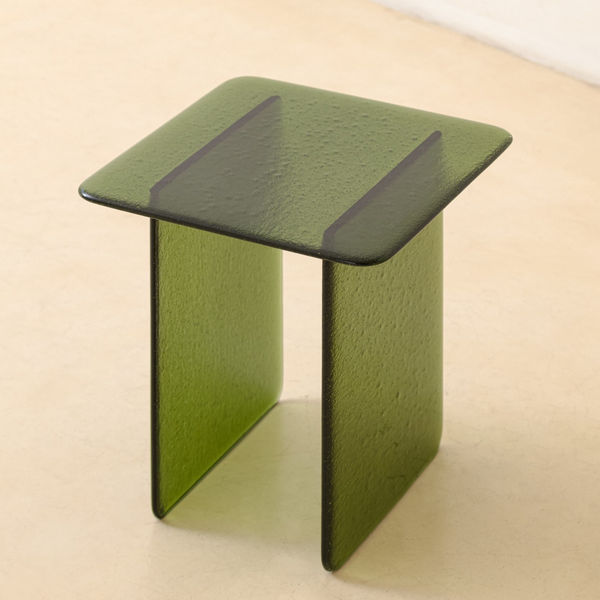
    The Mosai Side Table is constructed from sheets of colored glass assembled like a mosaic and fused in a single high-temperature process. The resulting surface contains subtle shifts between opacity and translucency, creating depth within the glass itself. When illuminated, the table projects colored light onto nearby surfaces, extending its presence beyond its physical boundaries. The piece reflects Recchia’s command of both glass fusion and optical behavior.


    CAVO SIDE TABLE, 2025

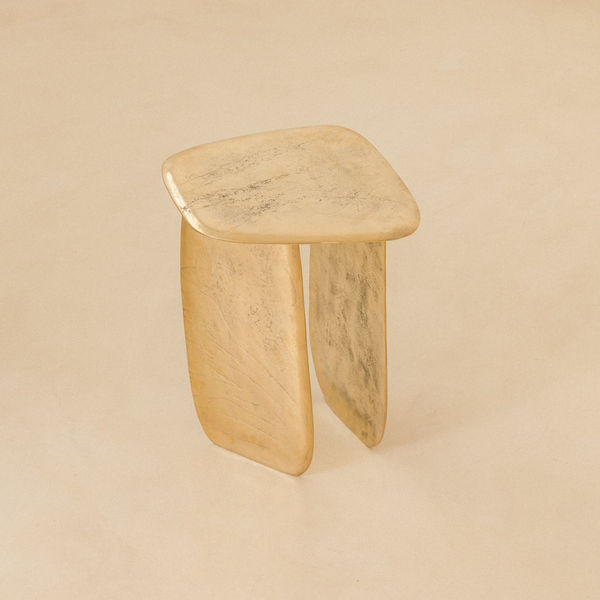
    Though recent, the Cavo series operates within the expanded Morfa universe through its cast-bronze construction and tensioned surfaces. The tables feature folded, planar volumes that read simultaneously as solid and finely edged. Presented in polished bronze and in a deep red oxidized finish, the two versions highlight contrasting qualities of the material—luminosity versus pigment, surface versus mass. Each piece distills strength and refinement into a compact sculptural form.

  • ECHE COLLECTION The Eche Collection is Lucas Recchia’s first series of seating, first presented in his solo show Elemental Echoes... ECHE COLLECTION The Eche Collection is Lucas Recchia’s first series of seating, first presented in his solo show Elemental Echoes... ECHE COLLECTION The Eche Collection is Lucas Recchia’s first series of seating, first presented in his solo show Elemental Echoes...

    ECHE COLLECTION

    The Eche Collection is Lucas Recchia’s first series of seating, first presented in his solo show Elemental Echoes in 2024. The collection includes three models: armchair, chaise lounge, and sofa. Cast bronze bases support the seats, balancing visual lightness with material solidity. Each piece explores the interaction of form, material, and space, transforming seating into sculptural, tactile objects crafted to endure.


    ECHE ARMCHAIR, 2024

    First unveiled in Elemental Echoes (2024), the Eche Collection marks Recchia’s entry into upholstered seating. The armchair is anchored by a cast-bronze base that supports the seat as if it were suspended, creating a deliberate contrast between structural force and visual levity. Upholstered in heavy mohair with bouclé for the backrest, the piece emphasizes texture
    and material duality. The Eche proposes seating as an architectural gesture: upright, intentional, and sculptural.

  • ZEL SIDE TABLE, 2025 The Zel Side Table extends ideas first introduced in the Morfa collection, incorporating hand-cut bronze elements... ZEL SIDE TABLE, 2025 The Zel Side Table extends ideas first introduced in the Morfa collection, incorporating hand-cut bronze elements... ZEL SIDE TABLE, 2025 The Zel Side Table extends ideas first introduced in the Morfa collection, incorporating hand-cut bronze elements... ZEL SIDE TABLE, 2025 The Zel Side Table extends ideas first introduced in the Morfa collection, incorporating hand-cut bronze elements... ZEL SIDE TABLE, 2025 The Zel Side Table extends ideas first introduced in the Morfa collection, incorporating hand-cut bronze elements... ZEL SIDE TABLE, 2025 The Zel Side Table extends ideas first introduced in the Morfa collection, incorporating hand-cut bronze elements... ZEL SIDE TABLE, 2025 The Zel Side Table extends ideas first introduced in the Morfa collection, incorporating hand-cut bronze elements...

    ZEL SIDE TABLE, 2025

    The Zel Side Table extends ideas first introduced in the Morfa collection, incorporating hand-cut bronze elements and particulate metal directly into molten glass during fusion. As the metal oxidizes, it forms bubbles, streaks, and occasionally figurative shapes—suns, stars, or abstract signs—embedded permanently within the glass. Each table is the product of an
    unpredictable meeting between bronze and glass, resulting in a truly singular object.


    CORIA SERIES, 2025

    Coria is Recchia’s first lighting model, cast in bronze or aluminum using textured molds that imprint different surface patterns—woven, rippled, or porous. Rather than acting as fixtures that project light outward, the sconces modulate the light that touches them, producing subtle gradients across the wall. Their presence is architectural, making the sconce function both as illumination and relief sculpture.

  • TRIPEDE TABLE, 2021 The Tripede side table was designed by Lucas Recchia in 2021. Carrying an enchanting charm with its... TRIPEDE TABLE, 2021 The Tripede side table was designed by Lucas Recchia in 2021. Carrying an enchanting charm with its... TRIPEDE TABLE, 2021 The Tripede side table was designed by Lucas Recchia in 2021. Carrying an enchanting charm with its... TRIPEDE TABLE, 2021 The Tripede side table was designed by Lucas Recchia in 2021. Carrying an enchanting charm with its... TRIPEDE TABLE, 2021 The Tripede side table was designed by Lucas Recchia in 2021. Carrying an enchanting charm with its... TRIPEDE TABLE, 2021 The Tripede side table was designed by Lucas Recchia in 2021. Carrying an enchanting charm with its... TRIPEDE TABLE, 2021 The Tripede side table was designed by Lucas Recchia in 2021. Carrying an enchanting charm with its... TRIPEDE TABLE, 2021 The Tripede side table was designed by Lucas Recchia in 2021. Carrying an enchanting charm with its...

    TRIPEDE TABLE, 2021

    The Tripede side table was designed by Lucas Recchia in 2021. Carrying an enchanting charm with its polished and patinated bronze composition adorned in a red patina. Embracing a contemporary and bold aesthetic, the Tripede side table seamlessly blends millennial techniques with bold design elements. Drawing inspiration from the essence of bronze as a material, the table’s shapes emerge through a fusion of manual and digital modeling. This versatile piece effortlessly complements various spaces, including living areas and bedrooms.


    ARCO SIDE TABLE, 2023

    Defined by arched bronze legs, the Arco Side Table explores stability through curvature. Available in polished bronze or black patina with a gold interior, the two versions highlight the range of expression possible within a consistent structural vocabulary.

  • EXPANDING THE DIALOGUE

  • FLOOR LAMP, 1960s The 1960s floor lamp by Dominici is constructed in polished brass, using a counterbalanced arm anchored to... FLOOR LAMP, 1960s The 1960s floor lamp by Dominici is constructed in polished brass, using a counterbalanced arm anchored to... FLOOR LAMP, 1960s The 1960s floor lamp by Dominici is constructed in polished brass, using a counterbalanced arm anchored to... FLOOR LAMP, 1960s The 1960s floor lamp by Dominici is constructed in polished brass, using a counterbalanced arm anchored to... FLOOR LAMP, 1960s The 1960s floor lamp by Dominici is constructed in polished brass, using a counterbalanced arm anchored to...

    FLOOR LAMP, 1960s

    The 1960s floor lamp by Dominici is constructed in polished brass, using a counterbalanced arm anchored to a slim dual-rod vertical support and a weighted circular base. The dome-shaped shade directs light downward, and the adjustable joints allow controlled positioning. Produced by Dominici Iluminação Moderna, the piece reflects the company’s shift toward locally manufactured modern lighting and carries a manufacturer’s stamp.


    UNTITLED, 1950s

    Di Cavalcanti - Oil on canvas
    H 25.39 in. x W 31.88 in.
    H 64.5 cm x W 81 cm

  • SESC POMPEIA STOOL, 1979-80 This iconic stool was designed by Lina Bo Bardi (1914-1992) and made especially for Sesc Pompeia,... SESC POMPEIA STOOL, 1979-80 This iconic stool was designed by Lina Bo Bardi (1914-1992) and made especially for Sesc Pompeia,... SESC POMPEIA STOOL, 1979-80 This iconic stool was designed by Lina Bo Bardi (1914-1992) and made especially for Sesc Pompeia,...

    SESC POMPEIA STOOL, 1979-80

    This iconic stool was designed by Lina Bo Bardi (1914-1992) and made especially for Sesc Pompeia, a cultural center in São Paulo, Brazil. It consists of structures that resemble crates made of pine wood. Lina’s attempt to make furniture of good design accessible to many people didn’t work as expected. Thus, from the middle 1950s, Lina focused on developing pieces
    with simple techniques and materials linked to her architectural projects.


    Designed by Lina Bo Bardi, Sesc Pompeia was elected in 2021 as one of the 25 most important post-war architectural works by The New York Times. The building works with a theater, exhibition space, auditorium, and open spaces that give breathing room in an agitated metropolis. The stools were part of the living areas, such as the dining hall and the library. A similar version is also used for the theater seats.


    The Sesc Pompeia project was created to revitalize an old abandoned factory built in 1938. The warehouses were restored from 1977 to 1982, and the sports block was inaugurated in 1986. The wear on this stool was intentionally kept to showcase its special history, whilst still being in very good vintage condition due to its strong quality material.